THE MIMAMSA PROGRAM
A three-year inquiry program, built to run deep
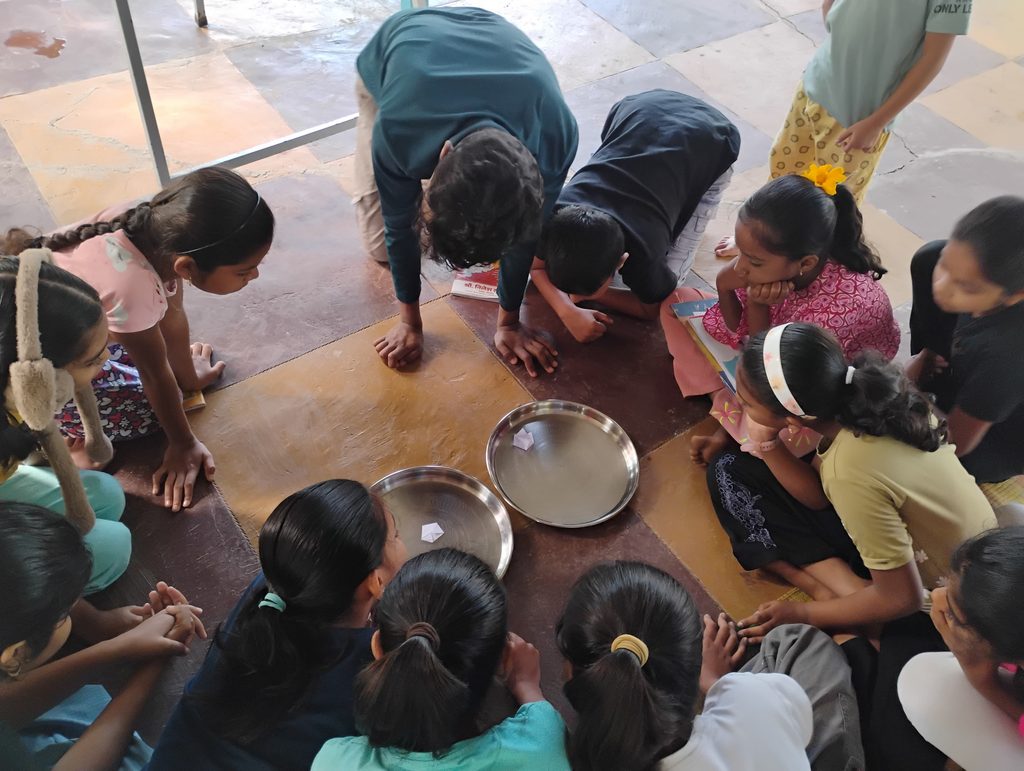
Our core offering is a structured, three-year inquiry program for children in Grades 6 to 8. It's built to grow slowly and deeply: children usually begin in Grade 6 and finish as they complete Grade 8. In some places, we start from Grade 5.
The themes
The program is organised into themes. Some span many sessions, others fewer — but each builds a distinct thinking skill.
Conceptual Inquiry
Many everyday questions can't be answered until we're clear about the words in them. "Is democracy good or bad?" goes nowhere until we ask what democracy is. "Am I successful?" only confuses until we ask what success means. Thinking carefully about "What is X?" is the heart of this theme.
Reasoning and Logic
We're always drawing conclusions from information. This theme teaches which conclusions actually follow and which don't — for example, that "where there's smoke there's fire" lets you infer fire from smoke, but not smoke from fire. Children learn the rules that separate a sound conclusion from a faulty one.
Classification
Sorting and grouping information helps children see its shape — what belongs where, and why. It's a key step toward abstract thinking and reflecting on one's own thinking (metacognition).
Critical Reading
In the age of WhatsApp and social media, misinformation spreads fast. Children learn to examine what they read, hear, and watch from several angles — to hold a news item, a forwarded message, or a video up to the light before believing it.
Historical Inquiry
What is history, and how is it written? What assumptions sit behind a history book, and is everything in one exactly true? Children learn what questions to ask of the past, and how wrong history can mislead.
First-Principles Thinking
Understanding ideas from the ground up rather than taking them on trust — across science, social science, and mathematics.
How do things work?
How does an ink pen write? What's inside a gas stove? Why does a zip hold shut? The answers may be a search away — but the point is to reason them out first, so children learn to depend less on ready-made information.
How to run an experiment
Stating a claim clearly, designing an experiment to test it, deciding what to observe, and working out which results would actually confirm it. Learned through small, real questions: Does it rain more during the day or night? Which detergent cleans better?
Theory Building
Using basic principles to explain what you observe — and realising that you, too, can take part in creating knowledge, not just read what others have discovered. Why does the volume change as a glass fills under a tap? How do we know the earth is round? Children learn to build explanations of their own.
Ethical & Philosophical Inquiry
We all hold views on right and wrong — but where do they come from? Are our views consistent? Where do our disagreements with others begin, and can people reason about ethics together?
Mathematical Thinking
Including computational, probabilistic and statistical thinking — going beyond calculation to genuine mathematical reasoning, often through games and puzzles that build a liking for the subject. This includes making sense of data, finding patterns, formalising patterns into formulae, and evaluating probabilities for better decisions.
What changes in a child
By the end of a single year, facilitators consistently see children who:
- observe more closely, using all five senses
- ask more questions, and are more curious
- frame their questions precisely
- have the confidence to ask a question in the first place
- design more rigorous experiments to test an idea
- recognise patterns quickly
- think about a problem from many angles, more openly and coherently
- notice when something doesn't add up
- understand scientific concepts more clearly
Where we work now
Mimamsa is currently running with children at five sites across Maharashtra.
Sondara Gurukul, Beed
Domri village
Working with teachers and Grade 5–7 students at this school near the small village of Domri.
Murbad, Thane district
Vaishakhare & Chausale villages
Daily online sessions plus an in-person session every two months, for low-income Grade 6–7 students.
Wada, Palghar district
Weekly hybrid delivery
A weekly online class plus an in-person session every two months.
Khelghar, Pune
Laxminagar settlement
Grades 5–8 at this organisation working in the Laxminagar settlement.
Swaroopvardhini, Pune
Four branches
Children from lower-income families across four branches of this Pune-based centre.
Bring Mimamsa to your children
If you run a school, centre, or NGO working with children who'd benefit from this, we'd like to hear from you.